 |
The Virgo Galaxy Cluster - Markarian's Chain
|
Copyright 2008 Hap Griffin
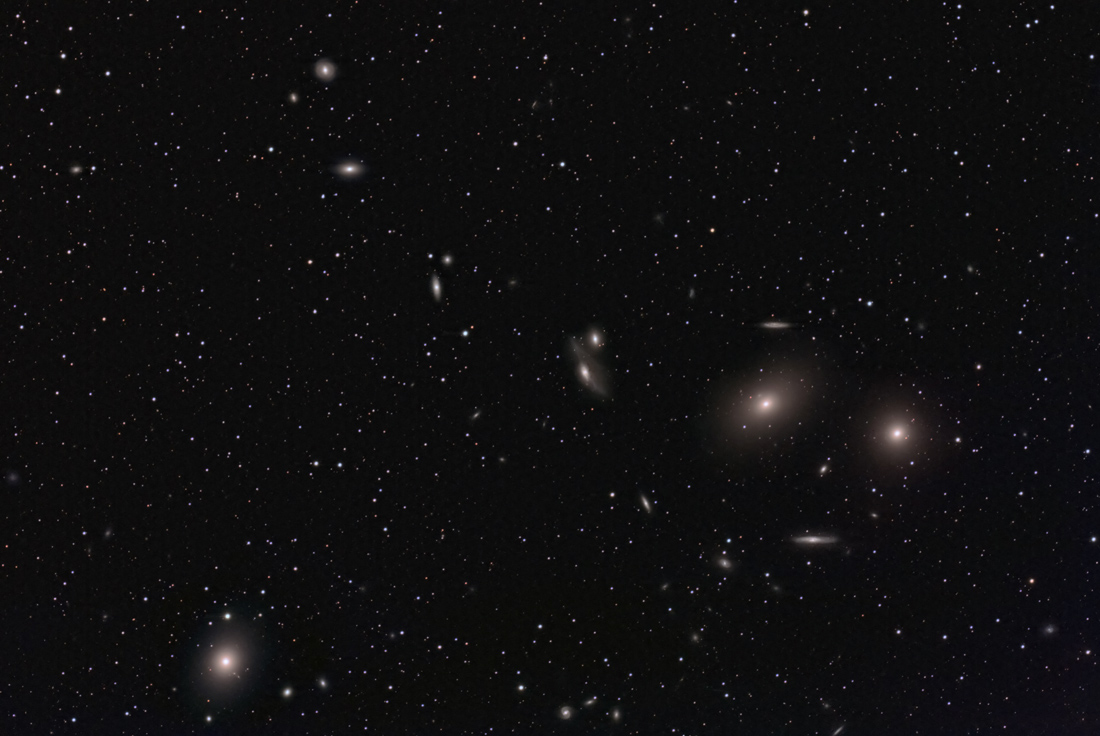
This is a wide-field shot of the western half of the remarkable galaxy cluster
in the constellation Virgo. If you look close, there are dozen's of
identifiable galaxies in this photograph.
The entire Virgo cluster contains some 2000 galaxies and represents an example of the largest structural unit in the Universe. It is gravitationally connected to the "Local Group" of galaxies of which our Milky Way is a member. While currently receding from the Virgo cluster, our Local Group is experiencing a slowdown because of its enormous gravity and will eventually be pulled into it.
The middle of this photograph is the collection of galaxies known as Markarian's Chain. The triangle of galaxies looking somewhat like a "face" at the lower right is anchored by the large linticular galaxy M86 with its close neighbor M84 to it's right. Below this pair and forming the "mouth" of the face, is the edge-on spiral NGC 4388. Above the "right eye" of the face and looking much like an "eyebrow" is another edge-on spiral, NGC 4402. Moving towards the left in this conspicuous chain is the interacting pair of galaxies, NGC 4438 and NGC 4435. Moving farther towards the left is the pair NGC 4461 and NGC 4458, followed by NGC 4473. The chain is completed by the pair of NGC 4477 and NGC 4479.
The large galaxy at the lower left is M87, the central galaxy in the Virgo Cluster. It is also a huge galaxy (larger than our own Milky Way) with a diameter of 120,000 light years and a mass of several trillion suns.
The galaxies of the Virgo Cluster lie at a distance of approximately 60 million light years. Thus, the light that arrived here on earth allowing this photograph to be taken originated shortly after the dinosaurs died out on our planet. When you pan through the hi-res version, contemplate about how you are literally a time travellor when looking at distant objects in our Universe.
Date/Location:
December 29, 2008 Griffin/Hunter II Observatory Bethune, SC
Instrument: Canon 40D Digital SLR (modified) through Takahashi
FSQ-106N APO refractor
Focal Ratio: F/5
Guiding: Auto through 10" Orion Newtonian on an AP-1200
mount via SBIG ST-402 CCD
Conditions: Visually clear sky glow from moisture present
Weather: 34 deg. F
Exposure: 180 minutes total @ ISO 800 (60 x 3 min exposures)
Filters: Baader UV/IR Block internal to camera
Processing: Focused and captured with ImagesPlus v3.50a Camera
Control.
RAW to TIFF conversion, frame calibrations, Digital Development, scaling and JPEG conversion with ImagesPlus
v3.75 Beta 4. Final tweaking in Photoshop CS3.