 |
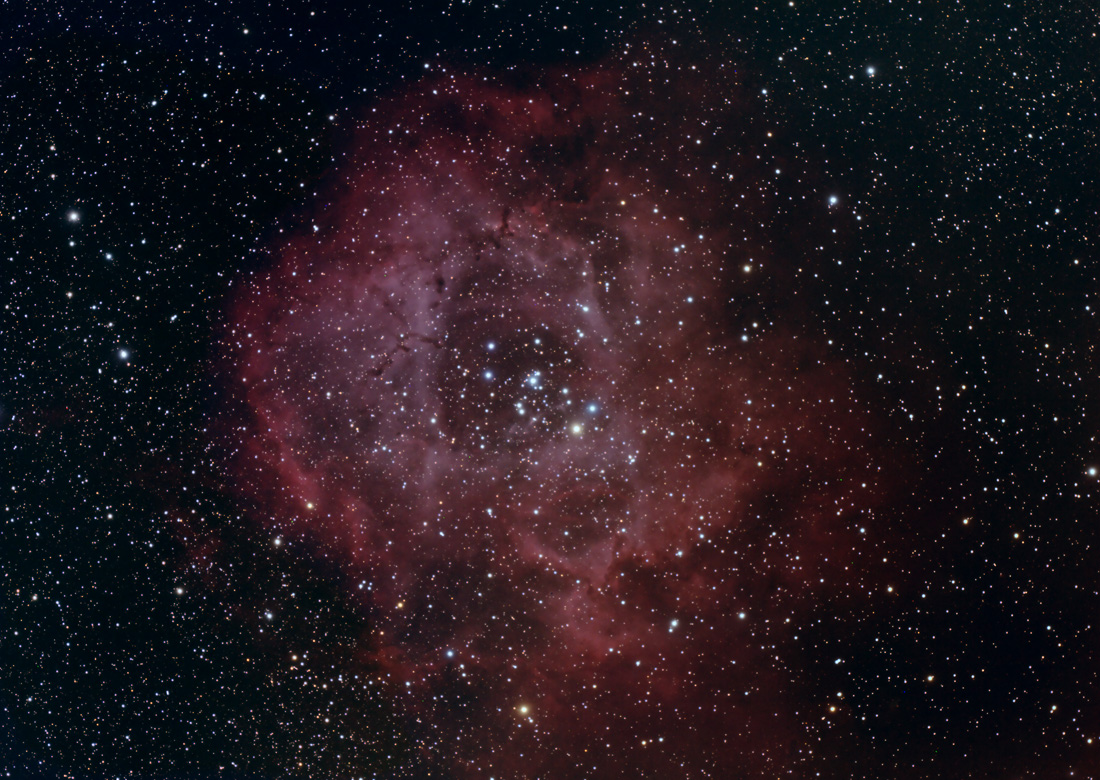
The Rosette Nebula in Monoceros
|
Copyright 2008 Hap Griffin
The Rosette Nebula, NGC 2237, certainly lives up to its name. A glowing cloud of hydrogen 130 light-years across, it is the birthplace of the loose star cluster in its interior (NGC 2244). This nebula is huge...although 2600 light-years distant, it spans roughly a degree of sky, or twice the diameter of the full moon. The central star cluster is visible to the naked eye, but the nebula itself is tough to see even in a telescope without a special optical filter such as a Lumicon UHC.
The dark, stringy objects scattered through the nebula are known as Bok Globules, named after Bart Bok, the astronomer who studied them extensively. They are regions of compressed gas and dust in the first stages of star formation.
Date/Location:
December 22, 2008 Griffin/Hunter
Observatory Bethune, SC
Instrument: Canon 40D (modified IR filtering) Digital SLR through
Takahashi FSQ-106 APO Refractor
Focal Ratio: F/5
Guiding: Auto via SBIG ST-402 through 10" Orion Newtonian
on an AP-1200 mount
Conditions: Visually clear and cold - some sky glow
Weather: 25 F
Exposure: 66 minutes total (22 x 3 minutes) @ ISO 800
Filters: Baader UV/IR block internal to camera
Processing: Focused and captured with ImagesPlus Camera
Control v 3.50a.
RAW to TIFF conversion, dark and flat frame calibration, Digital Development in
ImagesPlus v3.50a. FInal tweaking in Photoshop CS3.